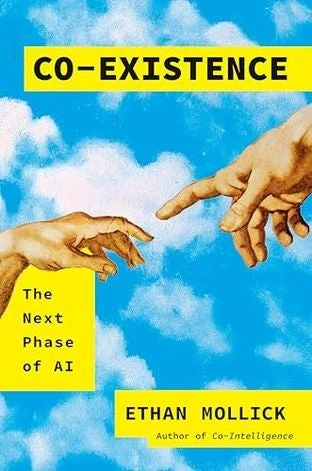
Co Existence
Ethan Mollick writes about living alongside artificial intelligence as a practical, human question rather than a technical one, which makes it unusually easy to talk about over a warm mug. Everyone arrives with a story already, whether they love these tools, dread them, or quietly use them at 11pm.
Come read Ethan Mollick with us and sit with the big questions in the smallest, warmest possible room. Tomato soup, grilled cheese, apple crumble, and absolutely no pressure to have finished the book.
Best for: A club that likes nonfiction they can argue about gently, with snacks, and no homework
Discussion
Warm-up
- 1.Before we talk about the book at all: what is the smallest, most ordinary thing you have ever asked an AI to help with? The kind of thing you would not admit at a dinner party.
- 2.Reading this, did you feel more like you were being reassured or being nudged? Settle in and tell us which mug-of-tea feeling you ended the book with.
Digging in
- 1.Mollick writes about AI as something you work alongside rather than something you simply use. Has anything in your own life ever shifted from a tool into something closer to a companion or collaborator, and how did that feel?
- 2.Which part of the book made your shoulders drop a little, in a good way? What worry did it quietly take off your plate?
- 3.And the opposite: was there a passage you had to put the book down after? Not to debate it, just to name the feeling it stirred up.
- 4.The book is interested in how we hold onto what is human while sharing the work. What is one small human thing you do (handwriting a card, cooking from memory, reading aloud) that you would never hand off, even if you could?
Going deep
- 1.By the end, the book leaves you somewhere specific emotionally. Without spoiling where it lands, how did your feeling about the next five years of your own work change between the first chapter and the last page?
- 2.If you could sit Mollick down at this table with a slice of something warm, what would you want to tell him about your own life that his book did not account for?
On the table & to sip
To eat
To sip
Run of show
Host tips
- Assume a third of the room did not finish it. Nonfiction clubs always have stragglers, so frame every question so a half-reader can answer honestly without embarrassment.
- This book makes people want to demo things on their phones. Let it happen for about five minutes, then gently pull the room back by asking someone a feelings question.
- Keep one genuinely skeptical voice welcome. If the whole evening tilts enthusiastic, ask directly what the book did not convince anyone of, and thank whoever answers.
Playlist
Soft electronics and warm acoustic instruments sitting comfortably together, low in the mix, humane and a little wistful. Keep it quiet enough to talk over.
- 01 An Ending (Ascent) - Brian Eno
- 02 Re: Stacks - Bon Iver
- 03 Oats in the Water - Ben Howard
- 04 Avril 14th - Aphex Twin
- 05 Open Eye Signal - Jon Hopkins
- 06 Holocene - Bon Iver
- 07 Nuvole Bianche - Ludovico Einaudi
- 08 Bloom - ODESZA
Trivia
- 1.What is Ethan Mollick's day job? (He is a professor at the Wharton School of the University of Pennsylvania.)
- 2.What is the name of the newsletter where Mollick publishes much of his writing and experimenting about AI? (One Useful Thing.)
- 3.Before AI became his main subject, what research area was Mollick best known for? (Entrepreneurship and innovation, including work on crowdfunding.)
- 4.Mollick is well known for pushing AI into one particular institution that he works inside. Which? (Education, especially the university classroom, where he has required students to use AI.)
- 5.What broad genre shelf does this book sit on? (Popular nonfiction, specifically technology and business or ideas writing rather than a technical manual.)
- 6.Mollick's best-known book title uses a coined 'co-' word to describe working with AI. What is the idea behind that prefix? (That the relationship is collaborative and shared rather than one of simply operating a tool.)
- 7.Mollick's writing is unusual among AI commentators for being based heavily on one activity. What? (Hands-on personal experimentation with the tools, published openly, rather than theory alone.)
- 8.This book arrived in the wave of general-interest AI books published after which technology reached the mainstream public? (Large language model chatbots, after ChatGPT's late-2022 public release.)
Bookmarks
Print, cut, and tuck one at every seat, a small keepsake from the night.
“Keep the kettle on. The future can wait a chapter.”
“Something new at the table, and still room for you.”
“Be curious slowly. That counts as keeping up.”
Rate the book
We hope the company was good and the conversation even better. Until the next chapter.