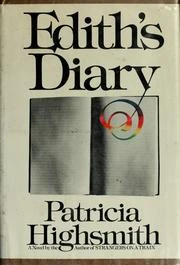
Edith's Diary
A quietly unsettling portrait of a woman in suburban Pennsylvania who starts keeping a diary and slowly lets the life on the page grow lovelier than the life in the house. It is Highsmith at her most domestic and most human, perfect for a night of soft lamps and softer voices.
Casserole, pie, a pot of tea that never runs out, and Patricia Highsmith's quietest, saddest, most domestic book. Come as late as you like and stay on the good couch.
Best for: A club that likes character studies, cares about the people in a book more than the puzzle, and wants a conversation that stays kind even when the material is sad
Discussion
Warm-up
- 1.Have you ever kept a diary or journal, even briefly? Tell us what you wrote in it and what you very deliberately left out.
- 2.Edith's life is full of small domestic rituals. What is one ordinary home ritual that comforts you, and did reading about hers make you notice yours differently?
Digging in
- 1.How did it feel to sit inside Edith's house for 320 pages? Did the setting read as cozy, suffocating, or somehow both at once, and where did that feeling shift for you?
- 2.Writing in the diary clearly soothes Edith. Which parts of her private writing felt genuinely comforting to you, and was there a point where the comfort started to ache a little?
- 3.This is a book about caretaking, about the endless looking-after of a house and the people in it. Did any of that land close to home for you, and how did you feel toward Edith while you read it?
- 4.Highsmith sets this in small-town Pennsylvania in a period of real political noise (Vietnam, Kennedy, the shifting 1960s and 70s). Did that background make the house feel safer or lonelier to you?
Going deep
- 1.Think about the moment you first felt a gap opening between what Edith wrote and what was actually happening. What did you feel in that moment, and did you want to keep reading or look away?
- 2.By the time you closed the book, what did you most want for Edith? Try to answer in the form of something you would say to her over a cup of tea, without spelling out how things go for her.
On the table & to sip
To eat
To sip
Run of show
Host tips
- Say out loud at the start that nobody has to have finished the book. This is a quiet story, people fall behind, and the warm-up and theme questions are built to work without the ending.
- It gets melancholy. When the room goes heavy, pivot to a domestic detail (someone's grandmother's casserole, a house they grew up in) and the warmth comes right back.
- Have one spare copy and a stack of index cards out. People will want to point at a passage, and some will rather write a thought down than say it.
Playlist
Warm, slightly worn-in American folk and soft 60s and 70s radio, the sound of a record playing in the next room while someone writes at the kitchen table
- 01 These Days - Nico
- 02 Pink Moon - Nick Drake
- 03 Our House - Crosby, Stills, Nash & Young
- 04 The Only Living Boy in New York - Simon & Garfunkel
- 05 A Case of You - Joni Mitchell
- 06 Everybody's Talkin' - Harry Nilsson
- 07 Hello in There - John Prine
- 08 Dreams - Fleetwood Mac
Trivia
- 1.In what year was Edith's Diary first published? (1977)
- 2.Patricia Highsmith is most famous for a 1950 debut novel adapted by Alfred Hitchcock. Name it. (Strangers on a Train)
- 3.Which charming con man did Highsmith write across five novels? (Tom Ripley, in the Ripliad, beginning with The Talented Mr. Ripley (1955))
- 4.Highsmith published a 1952 lesbian romance under the pen name Claire Morgan. What was it called, and what is it called now? (The Price of Salt, later republished as Carol)
- 5.In which U.S. state is Edith's Diary largely set? (Pennsylvania)
- 6.Highsmith was born in 1921 in which American state? (Texas (Fort Worth))
- 7.For most of her adult life Highsmith lived not in America but where? (Europe, including England, France and finally Switzerland, where she died in 1995)
- 8.Highsmith wrote a how-to book about her craft. What subject does it cover? (Writing suspense fiction (Plotting and Writing Suspense Fiction, 1966))
Bookmarks
Print, cut, and tuck one at every seat, a small keepsake from the night.
“The kettle is on. The notebook is open. Sit a while.”
“Some houses are kept tidy by the stories told inside them.”
“She wrote the afternoon the way she wished it had been.”
Rate the book
We hope the company was good and the conversation even better. Until the next chapter.