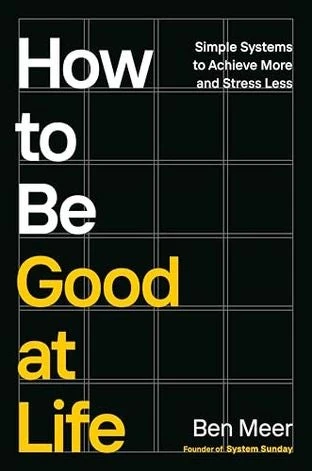
How To Be Good At Life
Ben Meer's guide turns the overwhelming project of self-improvement into small, kind, doable systems for body, mind, work, and relationships. It is the rare nonfiction pick that makes a book club feel like a group of friends gently cheering each other on.
Come over for grain bowls, three kinds of tea, and a slow conversation about Ben Meer's How To Be Good At Life. Wear whatever you would wear on your own couch, and bring yourself even if you only got halfway through.
Best for: A club that likes leaving a night feeling lighter, with one small idea they actually want to try
Discussion
Warm-up
- 1.Before we talk about the book at all: what is one tiny thing you already do that makes your day feel better, even if it sounds silly out loud?
- 2.Which section did you find yourself drawn to first (body, mind, work, or relationships), and what does that say about what you were needing lately?
Digging in
- 1.The book treats energy as something you can tend to rather than something you either have or do not. Did reading it change how you felt about your own tired days?
- 2.Was there a suggestion that felt like permission rather than pressure, something that let you off the hook instead of adding to the list?
- 3.The relationships material asks us to be intentional with the people we love. Who came to mind while you were reading, and did you reach out?
- 4.A lot of this book is about mornings, evenings, and the small shape of a day. What part of your own daily rhythm feels most comforting to you right now?
Going deep
- 1.By the time you reached the later chapters, had your idea of what being good at life means softened or shifted? What does it mean to you now, in your own words?
- 2.If you could only carry one idea from this whole book into the next year, and you had to choose it based on what felt kindest to yourself rather than most impressive, what would it be?
On the table & to sip
To eat
To sip
Run of show
Host tips
- Say out loud at the start that nobody needs to have finished the book. This one is modular, and half-readers often have the best observations.
- Resist turning the night into a group accountability program. Keep it at one small thing per person, mentioned once, with no follow-up homework.
- Put the food out before the talking starts. People open up faster with something warm in their hands than they do across an empty table.
Playlist
Soft piano, acoustic guitar, and unhurried vocals: the sound of a Sunday evening when you are quietly getting your life together.
- 01 Holocene - Bon Iver
- 02 Saturn - Sleeping At Last
- 03 Gymnopedie No. 1 - Erik Satie
- 04 First Light - Nils Frahm
- 05 Harvest Moon - Neil Young
- 06 Slow Dancing in a Burning Room - John Mayer
- 07 Sunlight - Hozier
- 08 Re: Stacks - Bon Iver
Trivia
- 1.What is the broad genre of How To Be Good At Life? (Nonfiction self-improvement and personal development.)
- 2.Ben Meer is best known for a newsletter and online brand built around what concept? (Systems, specifically System Sunday and the idea of building personal systems.)
- 3.The book organizes life into a small number of core areas rather than one single focus. Name two of them. (Any two of body, mind, work, and relationships.)
- 4.Is this book structured as a continuous narrative or as modular, dip-in chapters? (Modular, which is why skimmers and completists can both join the conversation.)
- 5.Meer's approach favors which scale of change: dramatic overhauls or small repeatable systems? (Small repeatable systems.)
- 6.What kind of visual element does Meer frequently use to make ideas stick, both online and in the book? (Simple diagrams, frameworks, and visual checklists.)
- 7.Books in this genre are often shelved alongside which perennial bestsellers about habit formation? (Titles like Atomic Habits and The 7 Habits of Highly Effective People.)
- 8.Is How To Be Good At Life written in the first person with the author's own experience, or as detached academic research? (First person, with the author's own experience and experiments woven in.)
Bookmarks
Print, cut, and tuck one at every seat, a small keepsake from the night.
“Small warm habits, kept gently, add up to a life.”
“Tend your energy the way you tend a kettle.”
“Start with one good thing. Tomorrow, start again.”
Rate the book
We hope the company was good and the conversation even better. Until the next chapter.