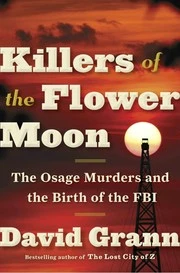
Killers of the Flower Moon
David Grann's true account of the Osage murders reads like a fireside mystery with real stakes, following an oil-rich Native nation in 1920s Oklahoma and the people who refused to let the truth stay buried. It is gripping without being lurid, which makes it a rare true-crime pick a whole club can sit with together.
Come sit in the warm kitchen with us for Killers of the Flower Moon. There will be a pot on the stove, cider on the counter, and no pressure to have smart things to say.
Best for: A club that loves narrative nonfiction and wants a book with real weight, discussed kindly over something warm
Discussion
Warm-up
- 1.Before you opened the book, had you ever heard of the Osage Nation or the oil boom on their land? What was it like to learn about it for the first time, and who did you want to tell about it?
- 2.Grann moves between different people's points of view. Whose chapters did you find yourself settling into most comfortably, almost relieved to be back with them?
Digging in
- 1.This is a book about a family that keeps gathering, keeps showing up for each other, through unimaginable loss. Was there a moment of that togetherness that warmed you, even in the middle of such a hard story?
- 2.The Osage lived under a guardianship system that put strangers in charge of their own money. How did it feel to read about adults being treated as if they could not be trusted with their own lives, and did it stir up anything personal for you about being managed or underestimated?
- 3.Grann writes about a place where neighbors, doctors, and lawmen were all woven together. Did the book change how you think about the small towns or tight communities you have lived in, for better or worse?
- 4.Mollie Burkhart's steadiness is often what readers hold onto. What did her presence in the book give you, and was there a woman in your own life she brought to mind?
Going deep
- 1.The last stretch of the book shifts from investigation to something more like remembrance, with Grann sitting with descendants and records. How did that change in temperature land on you emotionally, and what did you carry away from it?
- 2.When you closed the book, what did you feel you owed it: telling someone, reading more, visiting something, simply sitting quietly? Talk about what that impulse was and whether you have acted on it yet.
On the table & to sip
To eat
To sip
Run of show
Host tips
- Say up front that this is a hard history told gently, and that passing on any question is completely fine. Naming it once frees everybody for the rest of the night.
- Keep one phone handy for a map of Osage County and a photo or two from the era. Five seconds of looking grounds the whole conversation.
- Have a short list of what to read or watch next ready on an index card, because a lot of people finish this book wanting somewhere to put the feeling.
Playlist
Low, warm Americana: fingerpicked guitar, fiddle, and brushed drums, the kind of sound that sits under conversation without ever asking for the floor.
- 01 Wildflowers - Tom Petty
- 02 Oklahoma Hills - Woody Guthrie
- 03 Ohio - Over the Rhine
- 04 Red Dirt Girl - Emmylou Harris
- 05 Cold Missouri Waters - Cry Cry Cry
- 06 Indian Cars - Keith Secola
- 07 The Dark End of the Street - Cat Power
- 08 Hard Times Come Again No More - Mavis Staples
Trivia
- 1.In what year was Killers of the Flower Moon first published? (2017.)
- 2.Which magazine has David Grann been a staff writer for? (The New Yorker.)
- 3.Which earlier Grann book about an Amazon expedition also became a major film? (The Lost City of Z.)
- 4.In which U.S. state does the book's central story take place? (Oklahoma, in Osage County.)
- 5.What natural resource discovered beneath Osage land made the nation extraordinarily wealthy in the early 20th century? (Oil.)
- 6.The young federal agency at the center of the investigation was later renamed what? (The Federal Bureau of Investigation (FBI).)
- 7.Who became director of that bureau in 1924 and led it for decades? (J. Edgar Hoover.)
- 8.The book's title comes from a time of year the Osage associate with blooming flowers. Which month does Grann connect to the flower moon? (May.)
- 9.Which acclaimed director adapted the book into a 2023 film? (Martin Scorsese.)
Bookmarks
Print, cut, and tuck one at every seat, a small keepsake from the night.


Rate the book
We hope the company was good and the conversation even better. Until the next chapter.