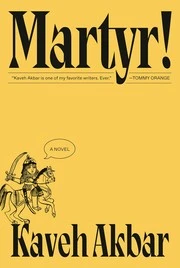
Martyr!
A tender, funny, grief-soaked novel about an orphaned Iranian American poet in recovery who goes looking for a meaningful way to live (and maybe die), and finds unexpected people to love along the way. It is lyrical and lonely and warm all at once, which makes it perfect for a soft-lit room full of friends.
Come read Martyr! with us in socks. There will be a pot of herb soup, endless cardamom tea, dates on a plate, and gentle questions about grief, family, and what makes a life feel like it counts. Bring one sentence you underlined.
Best for: A club that likes beautiful sentences and does not mind getting a little misty over tea
Discussion
Warm-up
- 1.Where did you do most of your reading of this one, and did you find yourself needing a blanket, a snack, or a break? This book has a way of asking for all three.
- 2.Cyrus is a poet keeping a running list of ideas and notes. If you kept a notebook like that this month, what small thing would be in it?
Digging in
- 1.Cyrus is looking for a death that means something, which is really a way of asking for a life that means something. When you were reading, what gave you the feeling that your own days count? Keep it small and ordinary if you like.
- 2.So much of this book is about being loved by people who are not your parents: friends, roommates, sponsors, strangers. Who has been that kind of family for you, and did any scene here remind you of them?
- 3.Akbar writes about longing for a country and a language that feel partly yours and partly out of reach. Is there a place, a language, a recipe, or a grandparent's phrase you feel that pull toward?
- 4.Recovery in this novel is shown as unglamorous and daily, mostly rooms and coffee and phone calls. Did that depiction feel comforting to you, or hard to sit with, and why?
Going deep
- 1.The word martyr carries honor, horror, and a kind of showing off, all at once. By the time you closed the book, had your feeling about that word softened, hardened, or just gotten more complicated? No need to say what changed it.
- 2.This is a book full of absences: a mother, a country, a God who may or may not be listening. Which absence stayed with you after the last page, and did the book leave you feeling tended to or unsettled?
On the table & to sip
To eat
To sip
Run of show
Host tips
- This book touches suicidal ideation, addiction, and parental loss. Say once at the start, warmly, that anyone can pass on any question, and mean it. Then do not make it a big deal.
- Give people something to hold: a tea glass, a soup bowl, a pillow. Hands busy means hearts open, and it saves the shy ones from eye contact.
- Ask everyone to bring one sentence they underlined. It is the easiest on-ramp with a poet's novel, and it rescues any conversation that stalls.
Playlist
Soft, slightly aching, mostly acoustic, with Persian strings woven in. Low volume, the kind of sound that makes a room feel padded.
- 01 Gole Yas - Mohsen Namjoo
- 02 Gol-e Sang - Googoosh
- 03 Ye Kam Bokhand - Mohsen Namjoo
- 04 Harvest Moon - Neil Young
- 05 Re: Stacks - Bon Iver
- 06 Motion Picture Soundtrack - Radiohead
- 07 Pink Moon - Nick Drake
- 08 Sorrow - The National
Trivia
- 1.Kaveh Akbar was known first for writing in which genre before Martyr! became his debut novel? (Poetry. His collections include Calling a Wolf a Wolf and Pilgrim Bell.)
- 2.What country was Kaveh Akbar born in, and where did he grow up? (He was born in Tehran, Iran, and grew up in the United States.)
- 3.In what year was Martyr! published? (2024.)
- 4.Martyr! became a bestseller on which famous American list in early 2024? (The New York Times hardcover fiction list.)
- 5.The protagonist, Cyrus Shams, shares his first name with a famous ruler of ancient Persia. Who? (Cyrus the Great, founder of the Achaemenid Empire.)
- 6.Addiction and sobriety are central to the novel. What is the main character's relationship to substances at the start? (He is in recovery, newly and shakily sober.)
- 7.Akbar has also worked extensively as what kind of literary gatekeeper, championing other poets? (A poetry editor (including at The Nation) and interviewer of poets.)
- 8.What does the word martyr originally mean, from its Greek root martys? (Witness. Someone who testifies.)
Bookmarks
Print, cut, and tuck one at every seat, a small keepsake from the night.
“Hold the tea with both hands. Grief can wait a minute.”
“Some nights, staying is the bravest poem you write.”
“A mother tongue tastes like cardamom and someone's kitchen.”
Rate the book
We hope the company was good and the conversation even better. Until the next chapter.