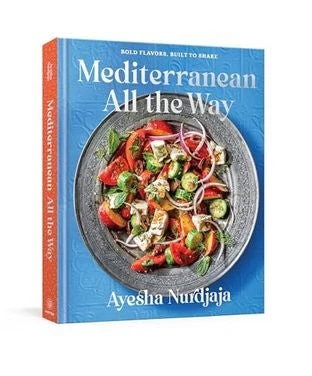
Mediterranean All The Way
Ayesha Nurdjaja's debut cookbook is a sun-soaked tour of the Mediterranean through one chef's layered heritage, where spice, citrus, and char do the talking. It reads like a friend handing you her kitchen notebook, which makes it a dream for a club that likes to cook and linger.
We are reading Ayesha Nurdjaja's Mediterranean All The Way and taking it seriously enough to cook from it. Bring your dog-eared pages, your appetite, and nothing else.
Best for: A club that cooks together, talks with its mouth full, and treats dinner as the discussion
Discussion
Warm-up
- 1.Flip to the recipe you dog-eared first. What made you stop on that page, and have you actually made it yet?
- 2.Which smell from this book do you most want in your house on a cold evening: toasting spices, warm bread, garlic in olive oil, or citrus peel?
Digging in
- 1.Nurdjaja draws on a mixed heritage and a wide Mediterranean. Did reading her move you to think about the mixed food map in your own family, and what lives on it?
- 2.This book is unembarrassed about olive oil, salt, lemon, and char. Which of those did you feel permission to use more freely after reading, and did that feel freeing or a little reckless?
- 3.Some recipes here are built for feeding a crowd. Who did you picture at your table while reading, and what did that daydream feel like?
- 4.The headnotes carry a chef's voice: direct, warm, a little bossy. Did having someone speak to you that way in the kitchen comfort you or make you nervous?
Going deep
- 1.Cookbooks like this ask you to trust a stranger with your dinner. Where in the book did you feel most trusted as a cook, and where did you feel most out of your depth, and what did each do to your confidence?
- 2.By the last pages, had your sense of what Mediterranean cooking means shifted or widened? Sit with where it landed, and what you want to carry into your own kitchen from here.
On the table & to sip
To eat
To sip
Run of show
Host tips
- Cook one thing from the book yourself and let the rest be store-bought or potluck. The point is the table, not a test.
- Keep the book open on the counter and let people wander over to it mid-conversation. A cookbook club works better standing up than seated in a circle.
- Have a spoon and small bowls out for tasting. People talk more honestly about food they are actively eating.
Playlist
Low-lit and lamp-warm: oud and nylon strings, soft percussion, voices that sound like someone cooking in the next room.
- 01 Hal Asmar Ellon - Fairuz
- 02 Fiyya - Souad Massi
- 03 Ya Rayah - Rachid Taha
- 04 Mediterranean Sundance - Al Di Meola and Paco de Lucia
- 05 Lili Twil - Bachar Mar-Khalife
- 06 Tam Tam - Mashrou' Leila
- 07 Il Cielo In Una Stanza - Mina
- 08 Dina - Rodrigo Leao
Trivia
- 1.Who is Ayesha Nurdjaja's co-writer on this cookbook? (Casey Elsass.)
- 2.Which New York City restaurant is Nurdjaja best known as the chef of? (Shuka, in SoHo.)
- 3.Is this Nurdjaja's first cookbook? (Yes, it is her debut.)
- 4.The book's Mediterranean stretches well beyond one country. Name two regions its cooking draws on. (Any two of: North Africa, the Levant, Italy, Spain, Greece, Turkey.)
- 5.Za'atar, used widely in this style of cooking, is a blend typically built around which three elements? (Dried wild thyme or oregano, sesame seeds, and sumac (plus salt).)
- 6.What does the spice sumac contribute to a dish? (A bright, tart, lemony sourness.)
- 7.Harissa, a staple of North African cooking, originates primarily from which country? (Tunisia.)
- 8.What is labneh? (Strained yogurt, thick enough to spread or scoop like a soft cheese.)
Bookmarks
Print, cut, and tuck one at every seat, a small keepsake from the night.
“Warm bread, cold night, nowhere else to be.”
“Olive oil, lemon, salt. The rest is company.”
“Toast the spices. Let the whole house know.”
Rate the book
We hope the company was good and the conversation even better. Until the next chapter.