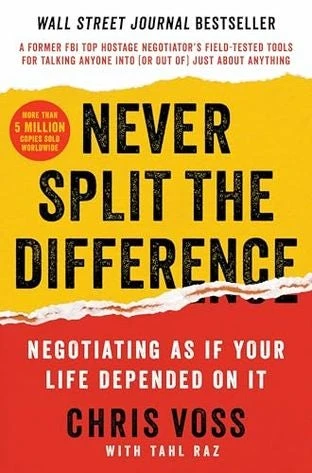
Never Split The Difference
A former FBI hostage negotiator turns high-stakes crisis tactics into gentle, everyday tools for being heard and hearing others. It is a business book that is secretly about empathy, and that makes it perfect for a soft-lamp evening of swapping stories.
Stew on the stove, coffee all night, and a book by an FBI negotiator who thinks the kindest thing you can do is actually listen. Bring slippers and one story about a time you should have said no.
Best for: A club that likes talking about their own lives as much as the book, and wants to leave feeling a little braver
Discussion
Warm-up
- 1.Before we start: what is one tiny thing you have been meaning to ask someone for, and have not? No pressure to say why.
- 2.Was there a moment reading this where you put the book down and thought about a specific conversation from your past? What pulled you back there?
Digging in
- 1.The book treats the phrase 'it seems like' as a way of handing someone your attention. How did it feel to imagine being spoken to that gently, instead of being argued with?
- 2.Voss insists that 'no' is often a comfort rather than a wall. Did that reframe soothe anything in you, or did part of you resist it?
- 3.The late-night radio voice is basically a recipe for making someone feel safe. Who in your life already talks to you like that, and what does it do to your shoulders?
- 4.A lot of this book asks you to stop defending yourself and start naming the other person's feelings out loud. Which felt harder to picture doing: staying quiet, or saying the uncomfortable thing kindly?
Going deep
- 1.Taken as a whole, the book suggests most conflict is really a person asking to be understood. Where in your own life would you most like to test that belief, and what makes that feel tender?
- 2.By the end you have a toolkit for getting what you want from people you love. Sitting with that, did it feel empowering, uncomfortable, or both, and how do you want to carry it?
On the table & to sip
To eat
To sip
Run of show
Host tips
- Model the book: when someone trails off, repeat their last few words instead of filling the silence. The room will go deeper on its own.
- Make 'pass' an explicit option out loud at the start. This book surfaces real memories about family and money, and permission to skip keeps it cozy rather than raw.
- Keep something warm in every hand at all times. Refilling a mug is the easiest way to signal there is no rush.
Playlist
Low, unhurried, and conversational. Think a late-night FM station playing just under the sound of people talking.
- 01 Moon River - Andy Williams
- 02 The Very Thought of You - Nat King Cole
- 03 In a Sentimental Mood - Duke Ellington and John Coltrane
- 04 Everybody's Talkin' - Shuggie Otis
- 05 Harvest Moon - Neil Young
- 06 Lean On Me - Bill Withers
- 07 Peace Piece - Bill Evans
- 08 Dindi - Stan Getz and Astrud Gilberto
Trivia
- 1.What was Chris Voss's role at the FBI? (He was the FBI's lead international kidnapping negotiator.)
- 2.Who co-wrote the book with Voss? (Journalist and co-author Tahl Raz.)
- 3.In what year was the book first published? (2016.)
- 4.What is the name of the negotiation firm Voss founded? (The Black Swan Group.)
- 5.The book's subtitle promises you will learn to do what? (Negotiate as if your life depended on it.)
- 6.Which Ivy League business school has Voss taught negotiation at? (He has taught at Georgetown and at the University of Southern California's Marshall School, and lectured at Harvard Law School.)
- 7.What calming speaking technique does Voss nickname after a radio personality? (The late-night FM DJ voice.)
- 8.What term does the book borrow from Nassim Nicholas Taleb for hidden, game-changing information? (Black swans.)
Bookmarks
Print, cut, and tuck one at every seat, a small keepsake from the night.
“Say less. Pour more. Let the silence do the asking.”
“Sometimes no is just someone asking to feel safe.”
“The kindest thing in the room is real attention.”
Rate the book
We hope the company was good and the conversation even better. Until the next chapter.