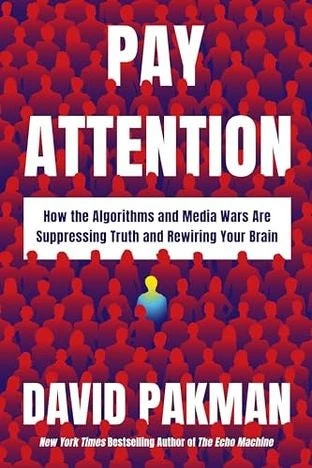
Pay Attention
David Pakman turns the question of why we cannot seem to hear each other anymore into something unexpectedly human, tracing how the tools in our pockets reshape what we believe and who we trust. It is a book that gives a club permission to talk honestly about their own screens, not just the country's.
We are reading David Pakman's Pay Attention and then talking it through over tomato soup, warm cider, and a crumble straight out of the pan. Come even if you only got halfway, and come ready to be kind about it.
Best for: A club that likes nonfiction about the world but wants to discuss it on a couch, in socks, with second helpings and no scorekeeping
Discussion
Warm-up
- 1.Before we start, what is the last thing you scrolled past today that you wish you had not? No judgment, we have all got one.
- 2.Where did you do most of your reading of this one, and did you have to put your phone in another room to get through it?
Digging in
- 1.The book is called Pay Attention. When was the last time you felt genuinely, restfully attentive to something, and what made that moment possible?
- 2.Pakman writes about how technology widens the distance between people. Is there someone you have quietly drifted from because of what the feeds did to one of you, and do you still miss them?
- 3.Which part of the book made you exhale with relief, as in finally someone said it out loud, and which part made your stomach drop a little?
- 4.Pakman makes his living in political media, the very machine he is examining. Did his willingness to point the lens at himself make you trust him more, and how did that land for you emotionally?
Going deep
- 1.By the time you closed the book, did you feel more tender toward the people you disagree with, or more tired? Sit with whichever one is true.
- 2.The later chapters move toward what we might actually do. Without spoiling where he lands, what is one small, unglamorous change you could make this month that you would not be embarrassed to report back on?
On the table & to sip
To eat
To sip
Run of show
Host tips
- Say out loud at the start that this is not a night for winning. If one person has strong politics and another does not, name that both are welcome and move on quickly.
- Keep food that reheats. People will drift between the kitchen and the couch, and a book like this gets its best moments in the kitchen doorway.
- Nobody finishes nonfiction on time. Tell people in the invite that partial readers are welcome, and your attendance will double.
Playlist
Low-volume, lamp-lit, mostly acoustic. Thoughtful without being sad, the sound of a room where people are actually listening to each other.
- 01 Harvest Moon - Neil Young
- 02 The Only Living Boy in New York - Simon & Garfunkel
- 03 Re: Stacks - Bon Iver
- 04 Pink Rabbits - The National
- 05 Keep Me in Your Heart - Warren Zevon
- 06 Motion Picture Soundtrack - Radiohead
- 07 Sea of Love - Cat Power
- 08 Slow Show - The National
Trivia
- 1.What is the title of David Pakman's earlier book, referenced in the description of this one? (The Echo Machine.)
- 2.What is the name of the long-running progressive political program David Pakman hosts? (The David Pakman Show.)
- 3.Pakman was born in which South American country before his family moved to the United States? (Argentina.)
- 4.Is Pay Attention fiction or nonfiction? (Nonfiction, political and media commentary.)
- 5.Pakman's show began in the 2000s on which older medium before becoming a major online video program? (Community/public radio.)
- 6.Besides his political show, Pakman holds a graduate business degree. What kind? (An MBA.)
- 7.The book's central concern is how technology affects what two things, per the publisher's description? (Political and cultural divisions.)
- 8.What English-language phrase serves as the book's title, and what does it ask of the reader? (Pay Attention, an instruction to direct focus deliberately rather than let it be taken.)
Bookmarks
Print, cut, and tuck one at every seat, a small keepsake from the night.
“Put the phone in the other room. The soup is ready.”
“We were never angry. We were only very tired.”
“Attention is the kindest thing you can hand someone.”
Rate the book
We hope the company was good and the conversation even better. Until the next chapter.