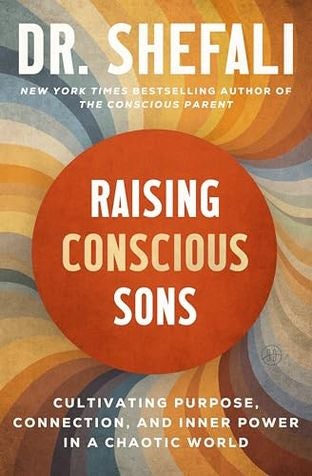
Raising Conscious Sons
Shefali Tsabary turns her conscious parenting lens toward boys, asking what happens when we stop shaping sons into a mold and start meeting who they already are. It is a short, tender read that hands every reader a mirror, which makes for an unusually honest and open-hearted club night.
Come read Shefali Tsabary's Raising Conscious Sons with us, in slippers, with dal on the stove and cookies coming out of the oven. Bring a marked page and no pressure to have any of it figured out.
Best for: A close, trusting club that likes slippers-on evenings and conversations that drift into the personal
Discussion
Warm-up
- 1.Before we talk about the book at all: what is one small, soft moment with a boy or young man in your life (son, nephew, brother, student, your own younger self) that you still think about fondly?
- 2.Where did you read this one, and did you find yourself putting it down to sit with a thought? What was the thought?
Digging in
- 1.Tsabary writes about the messages boys absorb about toughness. What is a message about being tough that you remember receiving or passing along, and how does it feel to name it out loud now?
- 2.The book keeps returning to the idea of seeing a child as he actually is. When have you felt genuinely seen by someone, not corrected or improved, and what did that warmth do for you?
- 3.Which passage about boys and their feelings loosened something in your chest, or made you want to text someone? Read us the bit that did it.
- 4.Tsabary suggests our own unhealed places drive how we parent. Rather than the hard version of that question, try the kind one: what part of yourself has a boy or young man in your life quietly helped you soften?
Going deep
- 1.By the time you closed the book, had your sense of what a son needs from you shifted, stayed steady, or gotten gentler? Talk us through the shape of that change without giving away where she lands.
- 2.The book asks a lot of the reader emotionally. Was there a moment where you felt defensive, and did that feeling eventually turn into something else? We will hold that story gently.
On the table & to sip
To eat
To sip
Run of show
Host tips
- Say explicitly at the start that passing on any question is completely fine. This book touches guilt, and permission to stay quiet is what keeps people talking.
- Keep the lighting low and the seating soft, and put the food within arm's reach of every seat so nobody has to get up and break a moment.
- Have a few sticky notes on hand so readers can flag a passage they want to read aloud. Reading someone else's words is the gentlest way into a personal answer.
Playlist
Low, unhurried, mostly acoustic. Piano, soft strings, and voices that sound like they are in the room with you.
- 01 The Book of Love - Peter Gabriel
- 02 Blackbird - The Beatles
- 03 Beautiful Boy (Darling Boy) - John Lennon
- 04 Holocene - Bon Iver
- 05 Gentle on My Mind - Glen Campbell
- 06 River - Joni Mitchell
- 07 Danny Boy - Sinead O'Connor
- 08 Saturn - Sleeping At Last
Trivia
- 1.Shefali Tsabary is usually credited with which professional title alongside author? (Clinical psychologist.)
- 2.Which parenting philosophy is Tsabary best known for popularizing? (Conscious parenting.)
- 3.Which earlier Tsabary book brought the conscious parenting idea to a wide audience? (The Conscious Parent.)
- 4.Which globally famous talk show host championed Tsabary's work and helped bring it to a mass audience? (Oprah Winfrey.)
- 5.Tsabary's approach blends Western psychology with traditions from which part of the world, reflecting her own upbringing? (Eastern philosophy, drawing on her Indian background.)
- 6.Is Raising Conscious Sons fiction or nonfiction? (Nonfiction, in the parenting and self-development space.)
- 7.A central claim of conscious parenting reverses the usual direction of growth. Who does Tsabary say has the most work to do? (The parent, not the child.)
- 8.The book's title pairs 'conscious' with a specific focus. What group does it center? (Boys and sons, and how they are raised.)
Bookmarks
Print, cut, and tuck one at every seat, a small keepsake from the night.
“Put the kettle on. Meet him where he already is.”
“His softness was never the thing that needed fixing.”
“Some lessons arrive in slippers, not in lectures.”
Rate the book
We hope the company was good and the conversation even better. Until the next chapter.