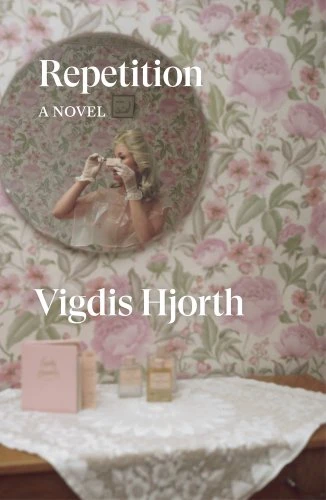
RepetitionBook club questions, food & host guide
 Library Science
A cozy book club night for Repetition by Vigdis Hjorth. Includes 8 spoiler-free discussion questions, food and drink pairings, a playlist, and a host guide, ready to print and share.
A club that likes small books with big feelings, and conversations that drift honestly rather than following a checklist
Buy links are affiliate links; we may earn a small commission, at no cost to you.
Vigdis Hjorth turns the small, circling motions of a life (memory, family, the things we return to again and again) into something quietly gripping. It is short, intensely felt, and almost impossible to read without wanting to talk about your own repetitions.
Why it works for clubs
- Hjorth writes interior life so precisely that everyone hears a different sentence as the loudest one
- The title itself is a conversation starter: what do we repeat, and why
- Short enough that everyone will actually finish it before the night
- Family, memory and self-justification are themes nobody at the table is neutral about
Warm-up questions
- 1 Settle in with your mug first: where did you do most of your reading of this one, and did the book want a quiet room or did it not care?
- 2 Hjorth's narration can feel like someone thinking out loud right next to you. Did that company feel comforting, or did you sometimes want to gently close the book and take a breath?
Digging in
- 1 The book is called Repetition. What is something you repeat (a route, a phrase, a season, a particular argument) that you have come to find oddly comforting?
- 2 Hjorth is so good at the weather of a family room, the mood before anyone speaks. Was there a scene where you recognized that atmosphere from your own life, and did recognizing it feel warm or a little bruising?
- 3 Norwegian writing often leans into long light and long dark. Which passage felt like the coziest moment in the book to you, the one you would happily have stayed inside longer?
- 4 This is a narrator who revisits her own story. When you tell a story about your past more than once, do you notice it softening, hardening, or quietly rearranging itself?
Going deep
- 1 Without giving anything away about where she lands: did you find yourself trusting the narrator's account of herself, and did your feeling about her warm up or cool down as the book went on?
- 2 By the last pages, did the book leave you feeling held or left a little exposed? Try to name the feeling you were sitting with when you closed it, rather than what happened.
On the table
To sip
Hushed Nordic piano and quiet folk, the sound of lamplight and a long winter afternoon indoors
- 01 Opening - Nils Frahm
- 02 Sleepsong - Olafur Arnalds
- 03 Fjara - Asgeir
- 05 Vals til Nina - Christian Wallumrod
- 06 Over the Hills and Far Away - Ane Brun
- 08 Pa Sorlandet - Jan Gunnar Hoff
Tap a track to play it. Full songs play when you're signed into Spotify.
Run of show
Host tips
- Say at the start that it is fine not to have finished, and that feelings are a valid contribution. Low pressure is the whole point.
- Keep food already warm and self-serve. A host who disappears into the kitchen takes the coziness with them.
- Let silences sit for a few seconds longer than feels comfortable. This book rewards it, and the quietest person at the table often speaks next.
Come read Vigdis Hjorth's Repetition with us, then sit in a warm room and talk about the things we all circle back to. Blankets, coffee and cardamom buns provided. Finishing the book is encouraged, not required.
Trivia
-
1
What nationality is Vigdis Hjorth?Answer: Norwegian.
-
2
Which of Hjorth's novels, translated by Charlotte Barslund, became her international breakthrough and was shortlisted for the National Book Award for Translated Literature?Answer: Will and Testament (Arv og miljo).
-
3
In what decade did Hjorth publish her first book?Answer: The 1980s. She began publishing in 1983 with work for younger readers.
-
4
Hjorth is often grouped with a Norwegian literary trend known for drawing closely on the author's own life. What is that mode of writing commonly called?Answer: Autofiction, or in Norway the much-debated 'reality literature' (virkelighetslitteratur).
-
5
Which Norwegian city is the setting and backdrop for much of Hjorth's fiction?Answer: Oslo.
-
6
What language is Repetition originally written in?Answer: Norwegian, so English-language readers are reading it in translation.
-
7
Hjorth has won major Norwegian honours including the Brage Prize. What is the Brage Prize?Answer: Norway's leading annual literary award, given for the best books published in the country that year.
-
8
The title Repetition echoes a famous short book by a nineteenth-century Scandinavian philosopher on returning to the same experience. Who wrote it?Answer: Soren Kierkegaard, the Danish philosopher, whose Repetition appeared in 1843.
Bookmarks
Rate the book
Print pack
- Question cards on kraft stock, to be drawn from a bowl rather than read in order
- Printable bookmarks (three designs, cut and tucked into each guest's copy)
- A 'things I repeat' slip for each guest to fill in anonymously and read aloud from a jar
- Half-page scorecards with the cozy rating categories
- A small menu card listing the soup, buns, smorrebrod, coffee and saft
Get the kit in your inbox
We'll email you this kit now, then a friendly nudge before your meeting so planning never sneaks up on you.
Run this night with your club
Get a free club page with one link to text your group. They add their name, nominate books and vote on the next pick. No accounts, no passwords.
More book club night kits
Ready-made nights for other books your club might pick next.




Build a free kit for any book
Pick your next read, choose a vibe, and get discussion questions, food and drink pairings, a playlist, and a host guide in about a minute.
Build my night