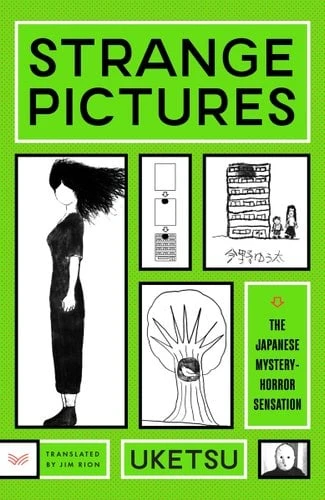
Strange Pictures
A quietly unsettling Japanese mystery told through a handful of odd drawings, where the real story hides in the margins of each picture. It is short, strange, and built to be puzzled over out loud with people you like.
Bring your copy of Uketsu's Strange Pictures and your best theory. There will be curry, hot tea, soft bread, and a room full of people squinting at the same drawing.
Best for: A club that likes a gentle thrill, loves a shared puzzle, and would rather compare hunches than dissect prose
Discussion
Warm-up
- 1.Flip to the first drawing that made you pause. What was the very first small detail your eye snagged on, and did you catch yourself wanting to show someone?
- 2.Where were you when you read this, and did you need a lamp on, a blanket, or a snack to get through it comfortably? Tell us your reading setup.
Digging in
- 1.This book trusts you to read pictures instead of just words. Did that feel playful and warm, like a puzzle handed to you, or did it make you a little anxious? Which did you enjoy more?
- 2.So much here lives in ordinary things: a sketch on a page, a page in a notebook, a drawing taped up somewhere. What everyday object in your own home holds more feeling than it looks like it should?
- 3.The book is built around people trying to say something they cannot say out loud. When has a drawing, a doodle, a note, or a photo been the easiest way for you to tell someone how you felt?
- 4.There is a lot of tenderness tucked inside this book's uneasiness, often around family and the people we protect. Which moment of care or protectiveness stayed with you after the chill wore off?
Going deep
- 1.Without giving anything away: once you understood how to look at these pages, did you feel comforted (the world makes sense after all) or more unsettled (it was there the whole time)? Sit with which of those is truer for you.
- 2.The book suggests people leave traces of themselves whether they mean to or not. Thinking about what you have made, written, or saved, does the idea of being read that closely feel like being known or like being exposed?
On the table & to sip
To eat
To sip
Run of show
Host tips
- Put a few blank sheets of paper and some pencils on the table. People will inevitably start sketching their own theories, and it is the best part of the night.
- Say up front: nobody has to have finished, and nobody has to have figured anything out. Then actively steer the room away from spoiling the final reveals for anyone mid-book.
- Keep the lighting low but not dim enough to strain eyes. Guests will be squinting at drawings all night, so a couple of lamps near the seating beats one overhead light.
Playlist
Hushed and warm with a faint draft underneath: soft piano, ambient hum, and a few quietly melancholy Japanese tracks for background only.
- 01 Gymnopédie No. 1 - Erik Satie
- 02 Merry Christmas Mr. Lawrence - Ryuichi Sakamoto
- 03 Aqua - Joe Hisaishi
- 04 Avril 14th - Aphex Twin
- 05 Light Dance - Hiroshi Yoshimura
- 06 Small Memory - Jon Hopkins
- 07 Mirage - Toshifumi Hinata
- 08 Experience - Ludovico Einaudi
Trivia
- 1.Uketsu, the author, is known for a very distinctive public persona. What does he always wear? (A white full-face mask, along with all-black clothing. He never shows his face or reveals his real name.)
- 2.Before becoming a bestselling novelist, where did Uketsu build his audience? (On YouTube, posting mystery and horror videos narrated in a distorted voice.)
- 3.What is unusual about the way Uketsu speaks in his videos and public appearances? (His voice is electronically altered, so his real voice has never been heard publicly.)
- 4.Strange Pictures belongs to a Japanese mystery style sometimes described by which term, referring to puzzles the reader solves alongside the characters? (The puzzle or fair-play mystery tradition, often linked in Japan to honkaku (orthodox) mystery writing.)
- 5.What is the central formal gimmick of Strange Pictures, the thing the whole book is built around? (Drawings. Each section hinges on interpreting illustrations included in the text.)
- 6.Uketsu wrote another widely translated novel built around a different kind of diagram. What is its English title? (Strange Houses (also published as Strange Houses / Strange Buildings in different markets), built around floor plans.)
- 7.In which country was Strange Pictures originally published, and in what language was it written? (Japan, in Japanese. It became a major bestseller there before being translated into English.)
- 8.The book is structured as several linked sections rather than one continuous narrative. What does this structure let the author do? (Present multiple separate-seeming cases and perspectives that the reader gradually connects, without any single section giving the whole picture.)
Bookmarks
Print, cut, and tuck one at every seat, a small keepsake from the night.
“Pour the tea. Then look again at the drawing.”
“Some kindness only fits inside a crooked little sketch.”
“Stay for one more cup. The lines are still moving.”
Rate the book
We hope the company was good and the conversation even better. Until the next chapter.