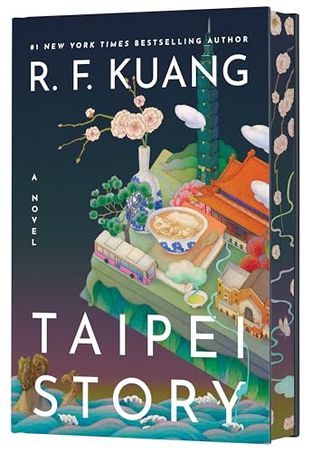
Taipei Story
A Chinese American college freshman spends a summer in Taipei and finds herself tangled in her family's history, a story about belonging, language, and the quiet ache of being a guest in a place that should feel like home. It is tender, searching, and exactly the kind of book that makes a room full of people start telling their own family stories.
Come eat beef noodle soup and drink too much oolong while we talk about a girl, a summer in Taipei, and the family stories none of us were given in full. Soft clothes encouraged, hot takes optional.
Best for: A club that likes character-driven stories and does not mind a discussion that drifts into everyone's own family photo albums
Discussion
Warm-up
- 1.What is the first small thing you remember noticing as you started reading, a smell, a street, a dish, a bit of weather, that made you feel like you had landed somewhere?
- 2.Where were you reading most of this book, and did you ever get up mid-chapter to text someone in your family or go looking for a snack?
Digging in
- 1.The book sits with the feeling of being a visitor in a place that is supposed to be yours. Have you ever felt that in a hometown, a relative's house, or a country you were told you came from, and what did it feel like in your body?
- 2.There is a specific loneliness in not having the right words in the right language. When has a language gap (or a generation gap) left you standing outside a conversation you wanted to be inside of?
- 3.What moment in the book comforted you rather than unsettled you, a meal, a kindness from a stranger, a quiet hour, and why did it land?
- 4.Families hand down history in fragments, half a sentence at dinner, a photo nobody explains. What fragment did your family hand you that you are still carrying around unfinished?
Going deep
- 1.By the end you have watched someone try to make peace with a history she did not choose. Without giving anything away, what did the book leave you feeling about whether that kind of peace is even possible, and did you want something different for her?
- 2.If you could sit down with the narrator on her last night in Taipei and say one kind thing, no advice, just kindness, what would you say to her?
On the table & to sip
To eat
To sip
Run of show
Host tips
- This book will pull real family stories out of people. Say up front that nobody has to share more than they want to, and mean it.
- Make the food self-serve and bottomless so you are never stuck in the kitchen while the best conversation is happening.
- Keep a couple of low lamps and blankets around instead of overhead lights. People say truer things in softer rooms.
Playlist
Humid-evening quiet: soft Mandopop, gentle guitars, and the kind of songs that sound like rain on a window unit.
- 01 Island's Sunrise - Fire EX.
- 02 Rainy Night - Crowd Lu
- 03 Tonight I Am Willing to Drift Toward the Sea - Deserts Chang
- 04 The Moon Represents My Heart - Teresa Teng
- 05 Wo Ai Ni - Elephant Gym
- 06 Room With a View - Sunset Rollercoaster
- 07 Rice Field Sun - Sodagreen
- 08 Nanwan - No Party For Cao Dong
Trivia
- 1.R.F. Kuang is best known for which earlier novel about a translator at Oxford? (Babel, published in 2022.)
- 2.What does the R.F. in R.F. Kuang stand for? (Rebecca F. Kuang.)
- 3.Kuang's debut trilogy, which began with a 2018 novel, is known by what name? (The Poppy War trilogy.)
- 4.Taipei is the capital of which island? (Taiwan.)
- 5.Taipei 101, the city's landmark skyscraper, briefly held what world title? (Tallest building in the world, from 2004 until 2010.)
- 6.What is the official language most widely used in Taipei? (Mandarin Chinese, alongside widely spoken Taiwanese Hokkien.)
- 7.Which beloved Taiwanese drink, made with tea, milk, and chewy tapioca pearls, became a global export? (Bubble tea (boba, or zhenzhu naicha).)
- 8.R.F. Kuang has pursued graduate study in Chinese studies at which two universities before her doctoral work at Yale? (Cambridge and Oxford.)
Bookmarks
Print, cut, and tuck one at every seat, a small keepsake from the night.
“Some cities remember you before you remember them.”
“Hold the bowl with both hands. Ask the question later.”
“Every family hands down a sentence it never finishes.”
Rate the book
We hope the company was good and the conversation even better. Until the next chapter.