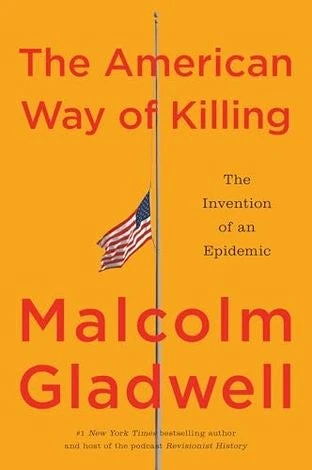
The American Way Of Killing
Gladwell turns his storyteller's curiosity on American homicide, asking why the numbers stay so high and why so little changes. It is a hard subject handled with a conversational, humane touch, which makes it unexpectedly good company for a slow evening of talk.
Come eat chicken and dumplings in our living room and talk gently about Malcolm Gladwell's The American Way Of Killing. Cider on the stove, blankets on the couch, no need to have finished every chapter.
Best for: A club that trusts each other enough to sit with a heavy subject in soft lighting, and would rather share feelings than debate statistics
Discussion
Warm-up
- 1.Before you opened the book, what did the title make your stomach do? Tell us where you were when you started reading it.
- 2.Gladwell is a familiar voice for a lot of readers. Did having him as the narrator here make a heavy topic easier to carry, like being walked through it by someone calm?
Digging in
- 1.Was there a chapter you had to set down for a minute? What did you do instead (made tea, went outside, called someone), and what brought you back?
- 2.Gladwell keeps asking why nothing changes. When in your own life have you felt that particular ache of watching a fixable problem stay broken?
- 3.The book is partly about how place shapes risk. How did reading it change the way you felt walking around your own neighborhood this week?
- 4.Which moment of unexpected tenderness or decency in the reporting stayed with you? Something that gave you a little room to breathe.
Going deep
- 1.Gladwell is gentle with people and harder on systems. Did that gentleness comfort you, or did part of you want him to be angrier? Be honest, no one is grading you.
- 2.Without giving away where he lands, what did the book leave you carrying: a heaviness, a small hope, or an urge to do one specific thing? Say the one thing out loud if you have it.
On the table & to sip
To eat
To sip
Run of show
Host tips
- Say out loud at the start that anyone can pass on any question. This book touches real losses, and someone in the room may have one.
- Keep the overhead lights off and use lamps and candles. People tell the truth more easily when they are not brightly lit.
- Do not try to resolve the policy argument. Your job is a warm room and a good pot of soup, not a verdict. If it turns into a debate, ask the next feelings question and let it drift back.
Playlist
Low and warm American roots music: back-porch guitar, dusty gospel, hushed soul. Sad in a comforting way, never grim.
- 01 A Change Is Gonna Come - Sam Cooke
- 02 The Weight - The Band
- 03 Harvest Moon - Neil Young
- 04 Wade in the Water - Eva Cassidy
- 05 America - Simon & Garfunkel
- 06 I Shall Be Released - Nina Simone
- 07 Casimir Pulaski Day - Sufjan Stevens
- 08 Keep Me in Your Heart - Warren Zevon
Trivia
- 1.What nationality is Malcolm Gladwell by birth, before his family moved? (British. He was born in England and raised in rural Ontario, Canada.)
- 2.Which magazine has Gladwell been a staff writer for since 1996? (The New Yorker.)
- 3.Which Gladwell book popularized the idea of the 'tipping point'? (The Tipping Point (2000), his first book.)
- 4.What is the name of the podcast Gladwell co-founded and hosts? (Revisionist History, from Pushkin Industries.)
- 5.Before becoming a magazine writer, which major newspaper did Gladwell report for? (The Washington Post.)
- 6.Which earlier Gladwell book is built around the idea that 10,000 hours of practice drives mastery? (Outliers (2008).)
- 7.Gladwell's 2024 book revisited his own most famous work. What was it called? (Revenge of the Tipping Point.)
- 8.What genre does this book belong to: narrative nonfiction, memoir, or true crime fiction? (Narrative nonfiction, Gladwell's signature blend of reporting, social science, and storytelling.)
Bookmarks
Print, cut, and tuck one at every seat, a small keepsake from the night.
“Hold the warm cup. Read the hard page anyway.”
“A country explains itself quietly, in numbers nobody reads.”
“Lamplight, leftovers, and a question that will not sit down.”
Rate the book
We hope the company was good and the conversation even better. Until the next chapter.