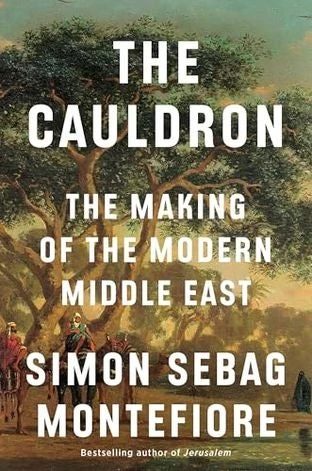
The Cauldron
Simon Sebag Montefiore follows his global bestseller "The World" with a sweeping, deeply human history of the Middle East, told through the people, families and cities that made it. It is the rare big history book that reads like a fireside story, which makes it perfect for a slow, snack-heavy night of talking.
Come read the Middle East with us, slowly. There will be mint tea, lamb and apricots, sticky cake, and absolutely no pressure to have finished the book.
Best for: A club that loves big narrative history and does not mind if half the group is still mid-book, as long as there is tea and something baked.
Discussion
Warm-up
- 1.Before you opened this book, what was the first image that came to mind when someone said "the Middle East"? No wrong answers, just whatever your brain handed you.
- 2.Which city in the book would you most want to be dropped into for one slow afternoon, and what would you want to eat while you were there?
Digging in
- 1.Montefiore keeps returning to families, kitchens, marriages and children inside enormous historical events. Which of those small domestic moments stayed with you the longest, and why do you think it stuck?
- 2.The book is built on the idea of a crossroads, of peoples constantly mixing and overlapping. Where in your own life have you felt that kind of layered, many-cultures-at-once feeling?
- 3.Was there a moment where you had to put the book down for a minute, either because it was too much or because it was unexpectedly tender? Tell us about that pause.
- 4.This region is the birthplace of so much we live inside: writing, cities, faiths, law. Which of those origins moved you most, and did any of it change how you think about something ordinary in your own day?
Going deep
- 1.Reading centuries of this region's history back to back, did you come away feeling heavier or oddly more hopeful about people? Be honest, and be gentle with each other's answers.
- 2.Montefiore chose to tell this through dynasties and individual lives rather than only forces and maps. By the time you reached his closing reflections, did that choice make the history easier to carry or harder? What did it let you feel that a drier telling would not?
On the table & to sip
To eat
To sip
Run of show
Host tips
- Say out loud at the start that this is a big book and partial readers are fully welcome. It completely changes the room's anxiety level.
- Keep a map of the region on the table or propped on a chair. People will crowd around it without being asked, and it saves a lot of confused gesturing.
- Prep the stew and the cake the day before. The cake is actually better soaked overnight, and you will want to be sitting down when guests arrive, not stirring.
Playlist
Low, unhurried, mostly instrumental: oud, ney, qanun and strings, the sound of a warm room late in the evening with the plates not yet cleared.
- 01 Oriental Dream - Anouar Brahem
- 02 The Astounding Eyes of Rita - Anouar Brahem
- 03 Lamma Bada Yatathanna - Le Trio Joubran
- 04 Nihavent Longa - Rabih Abou-Khalil
- 05 Chemirani - Kayhan Kalhor
- 06 Taqsim Nahawand - Simon Shaheen
- 07 Fi Hagat - Mashrou' Leila
- 08 Aatini Al Nay Wa Ghanni - Fairuz
Trivia
- 1.Which earlier global bestseller by the same author does "The Cauldron" follow? ("The World: A Family History of Humanity.")
- 2.Montefiore wrote a celebrated biography of one Soviet leader. Who? (Joseph Stalin (in "Young Stalin" and "Stalin: The Court of the Red Tsar").)
- 3.Which single city did Montefiore give its own full biography in an earlier book? (Jerusalem.)
- 4.What nationality is Simon Sebag Montefiore? (British.)
- 5.Montefiore's signature approach tells history through what unit, rather than through abstract forces? (Families and individual lives, including dynasties and households.)
- 6.The region covered by this book is often called the cradle of which human invention, dating to roughly 3,000 BC in Mesopotamia? (Writing (cuneiform).)
- 7.Which two rivers define the Mesopotamian heartland that features early in any history of this region? (The Tigris and the Euphrates.)
- 8.Besides history, Montefiore has also published work in which other genre? (Fiction (he has written novels, including a Moscow-set trilogy).)
Bookmarks
Print, cut, and tuck one at every seat, a small keepsake from the night.
“Empires rise and fall. The bread still gets passed.”
“Pull your chair closer. This story takes six thousand years.”
“Every map here was once somebody's kitchen.”
Rate the book
We hope the company was good and the conversation even better. Until the next chapter.