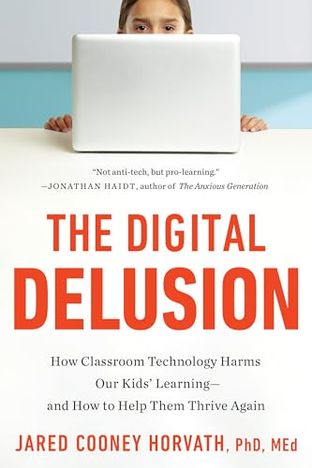
The Digital Delusion
A neuroscientist gently pulls back the curtain on our screens, asking whether all this digital convenience is quietly costing us the deep focus, memory, and connection we love. It is the perfect pick for a night of unplugging together.
Come unplug with us for a warm, low-key night of cocoa, comfort food, and gentle talk about The Digital Delusion. Wear your softest sweater and leave the notifications at the door.
Best for: a club that loves cozy nonfiction and heart-to-heart chats about how we actually live
Discussion
Warm-up
- 1.Where did you do most of your reading of this book, and did a favorite chair, blanket, or mug become part of the ritual?
- 2.Was there a page that made you set your phone face-down and just sit for a moment? Tell us about that little pause.
Digging in
- 1.The book celebrates slower, analog ways of learning and remembering. What is one low-tech comfort (a paper notebook, a real map, a printed photo) that the book made you feel newly tender toward?
- 2.As you read about how screens pull at our attention, which of your own everyday habits felt gently seen rather than scolded?
- 3.The book suggests our devices can crowd out quiet togetherness. When has putting a screen away made an ordinary evening feel warmer for you?
- 4.Which idea from Horvath do you most want to carry into your daily life, not as a strict rule but as a small kindness to yourself?
Going deep
- 1.By the time you closed the book, did you feel more hopeful or more wistful about our relationship with technology, and what moment tipped you that way?
- 2.The book asks us to notice what we may be trading away for convenience. Looking back over the whole read, what is one thing you feel quietly moved to protect or reclaim?
On the table & to sip
To eat
To sip
Run of show
Host tips
- Keep the lighting low with lamps or candles so the room feels like a den, not a meeting.
- Let silences breathe. In a cozy night, a thoughtful pause is a feature, not an awkward gap.
- Have spare blankets and refills ready so no one has to get up and break the mood.
Playlist
soft, unplugged, and lamplit, the sound of a phone left in another room
- 01 Holocene - Bon Iver
- 02 Harvest Moon - Neil Young
- 03 The Night We Met - Lord Huron
- 04 Slow Show - The National
- 05 Landslide - Fleetwood Mac
- 06 Home - Edward Sharpe and the Magnetic Zeros
- 07 Saturn - Sleeping at Last
- 08 Banana Pancakes - Jack Johnson
Trivia
- 1.What is the profession of author Jared Cooney Horvath that shapes this book? (He is a neuroscientist and educator who studies the brain and learning.)
- 2.The book's core concern is our relationship with what kind of technology? (Digital and screen-based technology.)
- 3.Is The Digital Delusion fiction or nonfiction? (Nonfiction.)
- 4.Horvath's work often focuses on which two brain-related processes highlighted in the book? (Learning and memory.)
- 5.Besides writing, Horvath is known for translating brain science into advice for which everyday setting? (Education and classrooms (how people learn).)
- 6.The book frequently contrasts digital habits with which older, hands-on alternatives? (Analog methods like paper, print, and handwriting.)
- 7.What word in the title signals the author's skeptical stance toward our screen assumptions? (Delusion.)
Bookmarks
Print, cut, and tuck one at every seat, a small keepsake from the night.
“Set the screen down and let the evening slow.”
“Paper, lamplight, and a mug that stays warm.”
“Your attention is a soft thing worth keeping.”
Rate the book
We hope the company was good and the conversation even better. Until the next chapter.