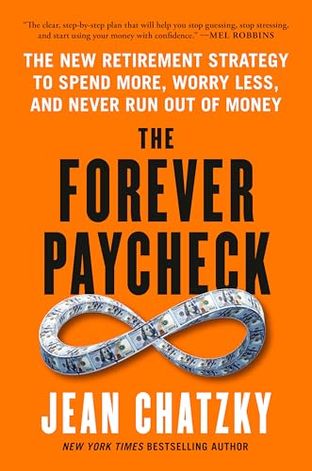
The Forever Paycheck
Jean Chatzky's The Forever Paycheck takes the scariest money question (will I outlive my savings?) and turns it into a calm, human conversation about building income that keeps showing up. It is the rare personal finance book that leaves a room feeling reassured rather than lectured.
Come eat something from a slow cooker and talk about money in the least stressful way possible. We are reading Jean Chatzky's The Forever Paycheck, and no spreadsheets, salaries, or shame are allowed at the door.
Best for: A club that likes a nonfiction pick with real-life stakes and wants to talk honestly, gently, and without anyone showing off a spreadsheet.
Discussion
Warm-up
- 1.Before you opened the book, what did the phrase 'a forever paycheck' make you picture? Tell us the first image that came to mind, even if it was silly.
- 2.Was there a moment reading this where your shoulders dropped a little, where Chatzky said something that felt like permission to stop worrying? Share that bit.
Digging in
- 1.Chatzky is interested in steady, reliable income rather than a big pile of money. Which of those two ideas feels more comforting to you personally, and why do you think that is?
- 2.A lot of us learned about money from someone (a parent, a grandparent, a first boss). Whose voice were you hearing in your head while you read this, and would that person have liked the book?
- 3.The book treats retirement as decades of living rather than a finish line. When you picture your own version of those years, what small ordinary thing do you most want to still be doing?
- 4.Chatzky's tone is warm and reassuring where a lot of money writing is alarming. Did that warmth make you trust her more, or did part of you want to be scared straight? Be honest, no wrong answer tonight.
Going deep
- 1.Somewhere in reading this you probably bumped into a gap between what you know you should do and what you actually do. Without confessing any numbers, what does that gap feel like for you, and what would make it feel smaller?
- 2.By the end, the book asks you to define 'enough' for yourself rather than chase a number someone else set. Sitting here tonight, what does enough look like in your life, and has this book nudged that picture in any direction?
On the table & to sip
To eat
To sip
Run of show
Host tips
- Say out loud at the start that nobody has to disclose salaries, debts, or balances. That one sentence is what makes an honest money conversation possible.
- Keep the lighting low and the serving dishes on the table rather than plating individually. Family-style eating keeps the tone gentle.
- If one person starts giving financial advice to the room, redirect warmly with 'and how did that part land for you?' to steer back to feelings and stories.
Playlist
Low-volume, warm-toned folk and soul for a lamp-lit living room, songs about work, time, and taking care of each other.
- 01 Harvest Moon - Neil Young
- 02 These Days - Nico
- 03 Long Time Coming - Brandi Carlile
- 04 Sunday Kind of Love - Etta James
- 05 Homeward Bound - Simon & Garfunkel
- 06 Forever Young - Bob Dylan
- 07 Gold in the Air of Summer - Kings of Convenience
- 08 The Weight - The Band
Trivia
- 1.What broad genre does The Forever Paycheck belong to? (Personal finance and money nonfiction.)
- 2.Jean Chatzky is best known to many readers as the longtime financial editor of which morning television program? (NBC's TODAY show.)
- 3.Chatzky hosts a long-running personal finance podcast. What is it called? (HerMoney.)
- 4.HerMoney is also the name of what else Chatzky founded? (A personal finance media company and platform aimed largely at women.)
- 5.Is The Forever Paycheck Chatzky's first book? (No. She has written a number of personal finance books over her career.)
- 6.The title phrase 'forever paycheck' points to what central financial idea? (Creating reliable, lasting income you cannot outlive, rather than just accumulating a lump sum.)
- 7.Before becoming a broadcast personality, Chatzky worked as a journalist at which personal finance magazine? (Money magazine.)
- 8.Who is the primary intended reader of a book like this? (Everyday people planning for or already moving into retirement, not professional investors.)
Bookmarks
Print, cut, and tuck one at every seat, a small keepsake from the night.
“Steady beats spectacular. Pour the cider, pull up a chair.”
“Enough is a feeling before it is ever a number.”
“Some paychecks arrive long after the work is done.”
Rate the book
We hope the company was good and the conversation even better. Until the next chapter.