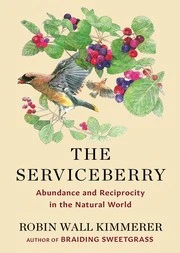
The Serviceberry
A slim, generous essay about serviceberries, gift economies, and what it means to live in reciprocity with the world around us. It reads in one sitting and leaves everyone wanting to talk about abundance, gratitude, and how they already give things away.
We are reading Robin Wall Kimmerer's The Serviceberry, 128 pages of gratitude you can finish in an afternoon. Soup, warm cider, a crumble in the oven, and absolutely no pressure. Bring a small something to give away.
Best for: A club that loves slow, heartfelt nonfiction and tends to end up swapping life stories instead of debating plot points
Discussion
Warm-up
- 1.What is a food you have picked with your own hands, from a bush, a tree, a backyard, or a roadside, and who were you with?
- 2.Before tonight, had you ever heard of a serviceberry? What did you picture when you read the title?
Digging in
- 1.Kimmerer writes about gifts that come with no invoice attached. What is something you have been given that you still feel quietly indebted to, in a good way?
- 2.Where in your own life does a gift economy already quietly run, the shared tools, the dropped-off soup, the overflowing zucchini? How does it feel to be inside it?
- 3.The book treats gratitude as a practice rather than a mood. Did any passage make you want to say thank you out loud to something that cannot hear you?
- 4.How did reading this change the way your own neighborhood or street looked on your next walk? Did anything suddenly feel more generous, or more stingy?
Going deep
- 1.Kimmerer holds Indigenous teaching and Western economics side by side without demanding you pick. Did that gentleness land as comforting, or did you find yourself wishing she pushed harder, and what does your answer say about you?
- 2.By the last pages, were you left feeling soothed or quietly unsettled about how you live? Share the feeling rather than the conclusion, and tell us one small thing you might actually do differently.
On the table & to sip
To eat
To sip
Run of show
Host tips
- Say up front that nobody has to have finished it. At 128 pages most will have, but the permission sets the whole tone.
- Set a low-light, soft-surface room: lamps instead of overheads, blankets on chair backs, one cozy chair per person if you can manage it.
- Have one actual serviceberry or saskatoon product on hand (dried berries, jam, even a photo of the shrub) so the title stops being abstract.
Playlist
Soft fingerpicked guitar, warm voices, and gentle ambient folk, the sound of late afternoon light moving across a kitchen table.
- 01 Harvest - Neil Young
- 02 Re: Stacks - Bon Iver
- 03 Ruby - Kathryn Williams
- 04 The Gardener - The Tallest Man on Earth
- 05 Horses in the Sky - Big Thief
- 06 Saskatchewan - Kacy & Clayton
- 07 Gratitude - Hiss Golden Messenger
- 08 Returning - Hania Rani
Trivia
- 1.Robin Wall Kimmerer is an enrolled member of which nation? (The Citizen Potawatomi Nation.)
- 2.What is Kimmerer's academic field? (Botany, specifically plant ecology. She is a professor of environmental biology and has done notable work on mosses.)
- 3.Which earlier Kimmerer book became a long-running bestseller and is often paired with The Serviceberry? (Braiding Sweetgrass (2013).)
- 4.In what year was The Serviceberry published? (2024.)
- 5.The central economic idea the book explores goes by what name? (The gift economy, where abundance is circulated rather than accumulated.)
- 6.Serviceberries belong to which plant genus? (Amelanchier, part of the rose family.)
- 7.Name two other common names for the serviceberry. (Saskatoon, juneberry, shadbush, and shadblow are all used for it.)
- 8.Kimmerer's earlier book about mosses won a John Burroughs Medal. What is its title? (Gathering Moss.)
Bookmarks
Print, cut, and tuck one at every seat, a small keepsake from the night.
“Take only what is offered. Leave the rest for the birds.”
“Abundance is a thing you pass along, still warm.”
“Enough is a kind of wealth. Sit down, have some.”
Rate the book
We hope the company was good and the conversation even better. Until the next chapter.