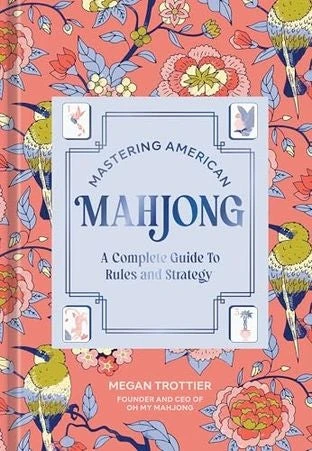
Mastering American Mahjong
A friendly, hands-on guide to American Mahjong that turns a famously intimidating tile game into something you can learn at a kitchen table with friends. It is the rare book club pick where the book itself hands you the evening's activity.
We are reading Mastering American Mahjong by Megan Trottier, then learning it together over congee and endless tea. Beginners especially welcome, confusion is part of the plan.
Best for: A club that likes doing something with their hands while they talk, and does not mind a little friendly confusion
Discussion
Warm-up
- 1.What is the game, card or otherwise, that you most associate with being taken care of by someone?
- 2.When you first opened the book and saw the tile illustrations, which suit or symbol did your eye go to, and did it feel pretty, puzzling or both?
Digging in
- 1.The book spends a lot of energy making a reputedly hard game feel approachable. Where in your reading did the fear drop away, and how did that moment feel?
- 2.American Mahjong is a game built around four people at one table for a long stretch of time. What does that kind of slow, seated togetherness give you that a quicker hangout does not?
- 3.So much of this game lives in sound and touch, the shuffling, the clack, the washing of the tiles. Which sensory detail from the book you most want to experience in person, and what does it remind you of?
- 4.The book treats beginners with real patience. Who in your life taught you something complicated kindly, and what did they do that made it safe to be bad at it first?
Going deep
- 1.Mahjong in America carries a long, layered history of borrowing, adaptation and belonging. Reading this, how did you feel about joining a tradition that was not originally yours, and did the book help you sit with that comfortably?
- 2.By the end, the book asks you to trust your own instincts at the table rather than follow a script. Is that a shift you welcomed, and where else in your life are you being nudged from following instructions to simply playing?
On the table & to sip
To eat
To sip
Run of show
Host tips
- Do not require anyone to have finished the book. This is a how-to, and people absorb it at wildly different speeds. Frame it as 'come as far as you got.'
- Print or borrow the current National Mah Jongg League card if you can, but have a simplified cheat sheet ready. Nothing kills a cozy night faster than four people squinting at tiny print.
- Say out loud at the start that nobody is keeping score and nobody has to play. Give people permission to just watch and eat.
Playlist
Low, unhurried and mostly instrumental, the sound of a warm room where the real music is tiles clicking.
- 01 Moon River - Henry Mancini
- 02 Spiegel im Spiegel - Arvo Part
- 03 Flower Drum Song Medley - Various Artists
- 04 Nuvole Bianche - Ludovico Einaudi
- 05 Dream a Little Dream of Me - Ella Fitzgerald and Louis Armstrong
- 06 Merry Christmas, Mr. Lawrence - Ryuichi Sakamoto
- 07 Blue in Green - Miles Davis
- 08 Comptine d'un autre ete - Yann Tiersen
Trivia
- 1.Mahjong originated in which country? (China, in the 19th century.)
- 2.American Mahjong uses a special printed card listing the valid hands. Which organization publishes the most widely used one? (The National Mah Jongg League.)
- 3.How often is that standard hand card updated? (Annually, a new card is released each year.)
- 4.American Mahjong adds a tile type that standard Chinese mahjong does not use. What is it? (Jokers.)
- 5.How many players sit at a standard mahjong table? (Four.)
- 6.Name the three main suits in a mahjong set. (Bams (bamboo), Cracks (characters) and Dots (circles).)
- 7.Mahjong became a nationwide craze in the United States during which decade? (The 1920s.)
- 8.What are the four honor tiles named after directions called? (The Winds: East, South, West and North.)
Bookmarks
Print, cut, and tuck one at every seat, a small keepsake from the night.
“Four chairs, one table, and all the time in the world.”
“Let the tiles clack. Let the tea go cold.”
“You are allowed to be new at this.”
Rate the book
We hope the company was good and the conversation even better. Until the next chapter.