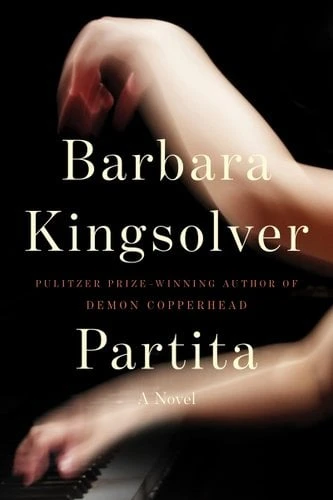
Partita
A warm, slow-burning novel about a piano teacher in rural Tennessee whose quiet life cracks open when a voice from her conservatory years calls after decades. It is a book about art, class, and the long cost of ambition, and it practically asks to be discussed over something warm in a mug.
Chicken and dumplings, skillet cornbread, cider on the stove, and Barbara Kingsolver's Partita, a quiet novel about a piano teacher in Tennessee and the life she almost had. Come early, stay late, no need to have finished the last fifty pages.
Best for: A long-running club that likes character-driven literary fiction, lingers over the emotional stuff, and would rather feel a book than dissect it
Discussion
Warm-up
- 1.Where did you do most of your reading of this one, and did you find yourself slowing down for it? Something about a piano-teacher book seems to invite a blanket and a quiet hour.
- 2.Was there an instrument, a lesson, or a teacher in your own childhood that you either loved or quietly dreaded? Livia's studio made a lot of readers go back to a bench somewhere.
Digging in
- 1.Teaching piano on a farm could read as a small life or a full one, depending on the day. Which way did it land for you while reading, and did the book make you feel tender toward that kind of quiet life or restless about it?
- 2.Kingsolver writes rural Tennessee with real affection. Which small domestic or outdoor detail of Livia's present-day life did you find most comforting to sink into, the kind of thing you would happily have read ten more pages about?
- 3.The novel is built like a partita, a set of linked movements rather than one straight line. Did that back-and-forth between the conservatory years and the present feel soothing to you, like returning to a familiar refrain, or did it keep you on edge?
- 4.Class sits under almost everything here, especially in the conservatory world. Was there a moment where you felt protective of Livia, where you wanted to reach into the page and tell her she belonged?
Going deep
- 1.The book calls itself a love affair between a life and an art. Thinking about the whole arc, how did it leave you feeling about the thing you once wanted badly and set down? Comforted, grieved, or a little of both?
- 2.Without giving away where it all lands, what did this book seem to believe about whether a person can be forgiven (by others, or by themselves) for the shape their life took? Did you close it feeling like Livia was carrying her past or finally setting some of it down?
On the table & to sip
To eat
To sip
Run of show
Host tips
- Resist the urge to make this a music-literacy quiz. Nobody needs to read music to feel this book, and one confident pianist in the room can accidentally silence everyone else.
- This story touches childhood trauma and family estrangement. Say early and lightly that anyone can pass on a question, then actually let a pass go by without comment.
- Do all the cooking in advance and keep it in pots. The host who is plating individual courses is the host who misses the best ten minutes of conversation.
Playlist
Solo piano and soft strings at low volume, the sound of a practice room with the door half closed, drifting toward Appalachian warmth by the end
- 01 Partita No. 1 in B-flat Major, BWV 825: Praeludium - J.S. Bach (performed by Glenn Gould)
- 02 Gymnopedie No. 1 - Erik Satie
- 03 Nocturne in E-flat Major, Op. 9 No. 2 - Frederic Chopin
- 04 Appalachian Spring: Simple Gifts - Aaron Copland
- 05 Older - Sarah Jarosz
- 06 Wayfaring Stranger - Rhiannon Giddens
- 07 The Blower's Daughter - Damien Rice
- 08 Spiegel im Spiegel - Arvo Part
Trivia
- 1.Partita was published in which year? (2026.)
- 2.A partita, in classical music, is what kind of piece? (A multi-movement instrumental work, essentially a suite of linked movements, most famously written by J.S. Bach.)
- 3.Livia Cable teaches piano in which US state? (Tennessee.)
- 4.Which university's conservatory holds the novel's earlier timeline? (Indiana University, home to one of the largest and most renowned music schools in the United States.)
- 5.Barbara Kingsolver won the Pulitzer Prize for Fiction for which earlier novel? (Demon Copperhead, in 2023.)
- 6.Kingsolver's Demon Copperhead was set in which region, one she returns to again and again? (Appalachia, specifically southwest Virginia.)
- 7.Before she was a novelist, Kingsolver worked in which field? (Science. She trained as a biologist and worked as a science writer and journalist.)
- 8.Roughly how long is Partita? (408 pages.)
Bookmarks
Print, cut, and tuck one at every seat, a small keepsake from the night.


Rate the book
We hope the company was good and the conversation even better. Until the next chapter.