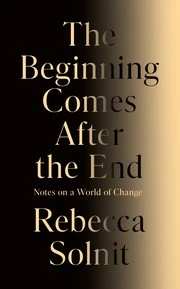
The Beginning Comes After the End
A slim, luminous book of essays from Rebecca Solnit on how endings quietly hand us beginnings, and how hope survives in uncertain times. At 160 pages it reads in an afternoon and gives a club hours of gentle, personal conversation.
Come over for a pot of white bean soup, warm cider, and a 160-page Rebecca Solnit book about endings that turn into beginnings. No homework, no hot takes, just comfortable chairs and good company.
Best for: A club that likes a slow, candid evening where the book is a doorway into each other's lives
Discussion
Warm-up
- 1.Where did you do most of your reading of this one, and did the setting (couch, bus, bath, porch) change how it landed for you?
- 2.It is a short book. Did you sip it one essay at a time or read it in one sitting, and which approach do you think suited your mood that week?
Digging in
- 1.Solnit keeps insisting that hope is a practice rather than a feeling. Where in your own life have you quietly practiced hope without naming it that?
- 2.Was there a sentence you had to put the book down after, just to sit with it for a minute? Read it to us and tell us why it stopped you.
- 3.The book treats endings as thresholds rather than losses. Think of an ending in your own life that turned out to be a doorway. What was on the other side?
- 4.Solnit is drawn to uncertainty as a place where good things can still happen. Does not knowing comfort you or unsettle you, and has that changed as you have gotten older?
Going deep
- 1.Reading this in 2026, with everything the last few years have asked of us, did the book feel like reassurance, like a nudge, or like a gentle challenge? Be honest if it was more than one.
- 2.By the time you closed the book, had anything softened in you (about the future, about other people, about yourself) that was hard before you opened it?
On the table & to sip
To eat
To sip
Run of show
Host tips
- Say explicitly at the start that it is fine if someone only read half. This book is essays, and a half-read copy still has plenty to say.
- Have sticky tabs or pencils in a bowl by the door. People who did not mark passages can flip and find one during the warm-ups.
- Resist filling pauses. The best answers to the deep questions arrive about six seconds after you think no one is going to answer.
Playlist
Soft, unhurried, mostly acoustic and instrumental, the sound of light coming back into a room
- 01 Re: Stacks - Bon Iver
- 02 Gymnopedie No. 1 - Erik Satie
- 03 Harvest Moon - Neil Young
- 04 Saturn - Sleeping at Last
- 05 The Light - Nils Frahm
- 06 River - Joni Mitchell
- 07 Holocene - Bon Iver
- 08 On the Nature of Daylight - Max Richter
Trivia
- 1.Rebecca Solnit is best known for popularizing which term, after her 2008 essay 'Men Explain Things to Me'? (Mansplaining (she did not coin the word herself, but her essay inspired it).)
- 2.Which city has Solnit lived in and written about for most of her adult life? (San Francisco.)
- 3.Solnit's 2004 book about activism and uncertainty shares a key theme with this one. What is its title? (Hope in the Dark.)
- 4.Which Solnit book is a cultural and personal history of walking? (Wanderlust: A History of Walking (2000).)
- 5.What genre does most of Solnit's work, including this book, belong to? (Nonfiction essays, often blending memoir, history, politics, and nature writing.)
- 6.Solnit wrote a book about how communities behave in the aftermath of disasters. What is it called? (A Paradise Built in Hell (2009).)
- 7.Solnit has written several 'atlas' books remapping cities with unconventional maps. Name one of the cities covered. (San Francisco, New Orleans, or New York.)
- 8.In what year was 'The Beginning Comes After the End' published? (2026.)
Bookmarks
Print, cut, and tuck one at every seat, a small keepsake from the night.
“Keep the kettle on. The dark is not the end of it.”
“Every closed door is somebody's hallway.”
“Read slowly. Some pages are meant to be sat with.”
Rate the book
We hope the company was good and the conversation even better. Until the next chapter.